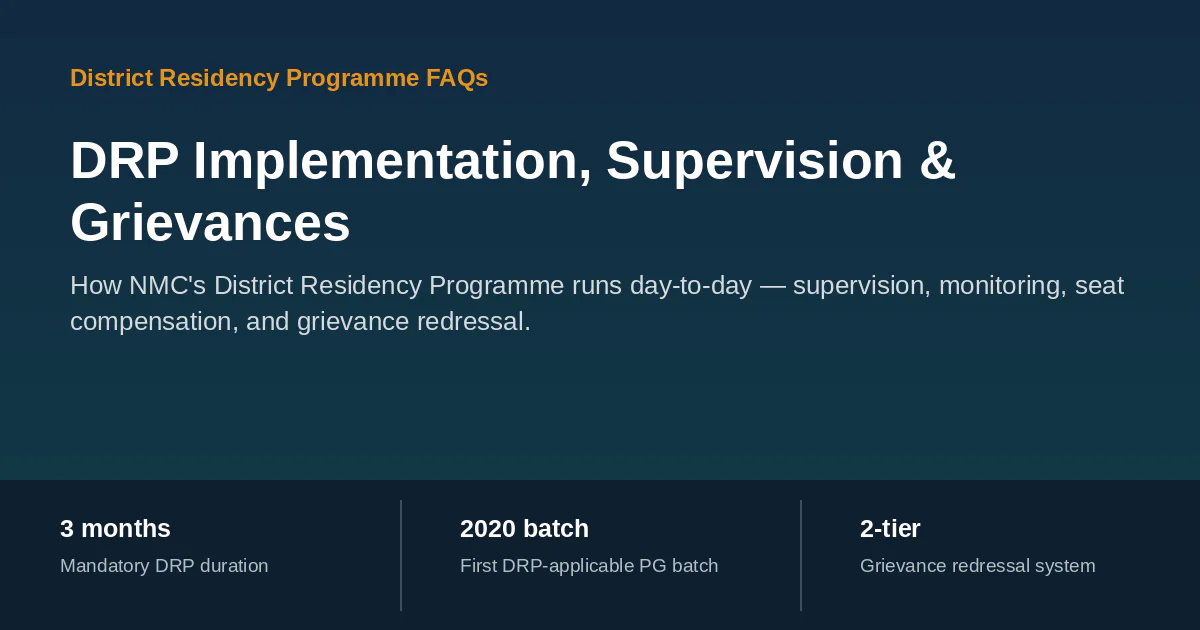
District Residency Programme (DRP) FAQs — Part 2: Implementation, Supervision & Grievances
Deeper questions on how NMC's District Residency Programme actually runs day-to-day — supervision, monitoring, seat compensation, and where to go if something goes wrong.
does drp training count as "training in a medical institution" for regulatory purposes?
Yes. The rule specifically states that training given as part of DRP in the District Health System is deemed to be training imparted in a medical institution — so it counts toward the student's official PG training record.
Source: PGMER (2000 amendment), Clause 13(1), proviso
can pg students be posted to another pg institution or super-specialty hospital for their drp instead of a district hospital?
No. NMC explicitly bars this — DRP postings are limited to public-sector/government-funded District Hospitals, CHCs, PHCs, Sub-Health Centres, Urban Health Centres and Community Outreach Systems. Posting at any postgraduate medical institution or super-specialty hospital is not permitted.
Source: DRP Clarification Circular, 19.01.2023
does drp only mean hospital postings, or does it also cover public health outreach work?
It's broader than the hospital itself — the "district health system" for DRP purposes also covers all public sector/government-funded facilities (sub-health centres, urban health centres) plus the community outreach system, including the district machinery running national and state public health programmes.
Source: DRP Clarification Circular, 19.01.2023
do pre-clinical and para-clinical pg students also have to do drp, and what do they do there?
Yes — students in Anatomy, Biochemistry, Physiology, Pathology, Microbiology, Pharmacology, Forensic Medicine and Community Medicine also do DRP, but their work looks different from clinical residents. They coordinate with the District Health Officer/Chief Medical Officer and contribute to diagnostic/lab services, pharmacy services, forensic services, general clinical duties, managerial roles, and public health programmes. They can also be posted to ICMR or other national research organisations' field sites, research units and labs.
Source: PGMER (2000 amendment), Clause 13(11)(vi)(b)
what clinical duties will a pg student actually be assigned during drp?
Clinical-specialty residents are posted with the matching specialty team/unit at the district hospital, under the overall guidance of the District Specialists posted there, and work under the District Residency Programme Coordinator (DRPC). Duties include OPD, inpatient wards, and casualty/emergency — this explicitly includes night duty.
Source: PGMER (2000 amendment), Clause 13(11)(vi)(a)
who is the district residency programme coordinator (drpc) and what do they do?
The DRPC is the official responsible for overall direction and supervision of District Residents at a given posting — effectively the person accountable for how DRP runs at that district hospital.
Source: DRP Clarification Circular, 19.01.2023
if a district hospital has no specialist in my specialty, who trains and supervises me during drp?
You're attached to whichever specialty team/unit is available or aligned at that district hospital and trained under the overall guidance of the District Specialists posted there.
Source: DRP Clarification Circular, 19.01.2023
do i still get a weekly off and normal leave during drp?
Yes. Subject to work exigencies, residents get one weekly holiday on a rotational basis, and remain entitled to leave benefits as per their parent college/university's rules — separate from stipend continuation.
Source: PGMER (2000 amendment), Clause 13(11)(vii)
do i lose touch with my home department and guide during the 3-month drp posting?
No — you're required to stay in phone/e-communication contact with your designated PG teacher(s) and department at the parent college, and are expected to participate remotely in scheduled case discussions, seminars, journal clubs and thesis discussions.
Source: PGMER (2000 amendment), Clause 13(11)(viii)(b)
how is my drp performance tracked and certified?
Training quality is monitored through logbooks, supportive supervision, and continuous performance assessment. Attendance and performance are tracked via an electronic or mobile-enabled system accessible to both the parent college and the state/UT Steering Committee. At the end, the DRPC issues a certificate of satisfactory completion plus a performance report to the medical college and the state/UT government.
Source: PGMER (2000 amendment), Clause 13(11)(viii)(a),(d)
does my medical college have to set up any internal committee for drp?
Yes. Every medical college/institution must set up a committee under its Academic Cell specifically to coordinate and monitor implementation of the District Residency Programme.
Source: PGMER (2000 amendment), Clause 13(11)(ix)
can pg students from one medical college be sent to a district hospital already tied to a different college?
Yes — students from other medical colleges can be deputed there too, provided their training is periodically monitored and is comparable in quality to the PG training given in a medical college hospital.
Source: DRP Clarification Circular, 19.01.2023
can drp be done at a district hospital that was recently upgraded into a medical college but only runs mbbs so far?
Yes, such hospitals aren't disqualified — they can still host PG students for DRP, under the same condition that training there is periodically monitored and kept comparable to standard PG training.
Source: DRP Clarification Circular, 19.01.2023
can my college get extra md ms seats to make up for residents being sent out on drp?
Yes — a college can apply for a proportionate enhancement of MD/MS seats under the Increase of Admission Capacity Regulations to compensate for the manpower loss caused by out-posting residents for DRP, but only after one year of DRP being implemented.
Source: PGMER (2000 amendment), Clause 13(11)(x)
how far in advance is a resident supposed to know their drp posting and hospital?
The State/UT DRP Nodal Officer, in consultation with the State Directorate of Health Services and the medical colleges, must identify suitable hospitals and prepare the placement schedule for residents due for rotation at least 6 months in advance.
Source: PGMER (2000 amendment), Clause 13(11)(xi)(b)
who do i complain to if something goes wrong during my drp posting?
There's a two-tier grievance mechanism: the State/UT DRP Nodal Officer handles grievance redressal at the state level, while the National Coordination Cell, set up under the Board of Governors/MCI, handles it at the national level.
Source: PGMER (2000 amendment), Clause 13(11)(xi)(b),(xiii)(c)
who approves leave for a district resident while posted away from their home college?
The District DRP Coordinator — a senior official of the district health system, nominated by the state government — is the competent authority for sanctioning leave to District Residents during the posting, and also handles their accommodation, transport and local grievances.
Source: PGMER (2000 amendment), Clause 13(11)(xi)(i)
is there a national body overseeing how states run drp?
Yes. A National Steering Committee — chaired by a Board of Governors/MCI nominee, with members from the Ministry of Health and Family Welfare, DGHS, and at least six state/UT governments — oversees implementation and submits quarterly reports to the central government. It has also set up a National Coordination Cell for smooth implementation and grievance redressal.
Source: PGMER (2000 amendment), Clause 13(11)(xiii)(a)-(c)
which pg batch was drp actually launched with?
The District Residency Programme was implemented starting with the PG (broad specialty) batch that joined in 2020.
Source: PGMER (2000 amendment), Clause 13(11)(xiv)
what's the underlying rationale nmc gave for creating drp?
The rule's preamble is built around two ideas — that PG training should come from and target community needs, and that doctors should train in diverse settings close to the community. The stated objectives are: exposing PG students to the district health system while they serve; familiarising them with planning, implementing and monitoring national health programmes at district level; and orienting them to the promotive, preventive, curative and rehabilitative services under the National Health Mission.
Source: PGMER (2000 amendment), Clause 13(11)(i)-(ii)
which regulation actually created the drp requirement — is the 2023 clarification circular itself the rule?
No. DRP was inserted into the Post Graduate Medical Education Regulations, 2000, via a notification dated 16 September 2020. Later circulars (like the one dated 19 January 2023) are only clarificatory annexures answering states' implementation doubts — the binding rule remains the 2020 notification.
Source: DRP Clarification Circular, 19.01.2023, cover letter

Related NMC Regulation FAQs
For more on PG training requirements and other NMC regulatory frameworks, see also:
For current academic openings, see our faculty vacancy listings across medical colleges.
This article is for general informational purposes based on our reading of the notified regulations and does not constitute legal advice. Requirements can be amended by NMC from time to time — please verify current rules directly with the National Medical Commission before making decisions.