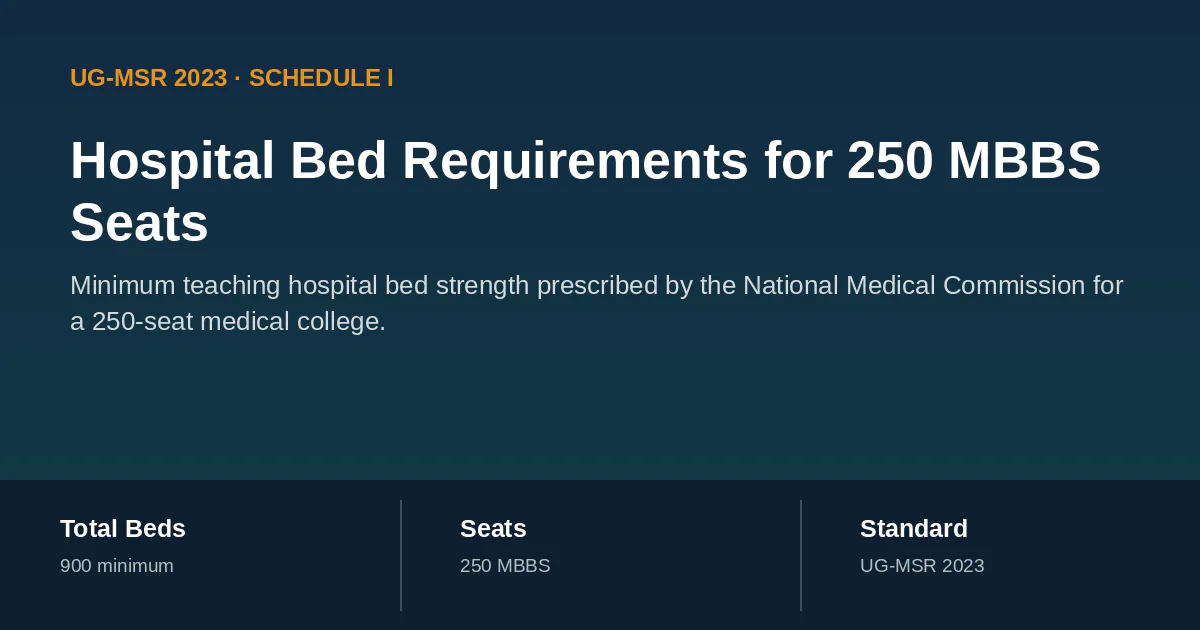
As per the Undergraduate Minimum Standard Requirements (UG-MSR) 2023 notified by the National Medical Commission, a medical college with an annual intake of 250 MBBS seats must have an attached teaching hospital with a minimum of 900 teaching beds, distributed department-wise as follows. This bed strength is assessed independently of faculty strength during MARB inspections, and colleges are expected to demonstrate both the physical infrastructure and the patient volume needed to sustain the clinical postings prescribed under the MBBS curriculum.
Department-wise Teaching Bed Requirement Table
Additional Hospital Requirements
In addition to the minimum teaching bed strength, the teaching hospital must also maintain:
Average indoor bed occupancy: at least 80% per annum
24×7 Emergency/Casualty Services with triaging facilities
Functional ICUs, including NICU, PICU, ICCU and other critical care units as prescribed under UG-MSR 2023
Minimum daily OPD attendance: 2,000 patients
Major Operation Theatres: 11

Bedside teaching rounds like this depend on a hospital having enough beds to sustain daily clinical training for every MBBS batch.
Why Bed Strength Matters for Your College
Teaching hospital bed strength isn't a paperwork formality — it directly determines how many patients your students and residents can be trained on, and it's one of the first things NMC's Medical Assessment and Rating Board (MARB) verifies during inspections and renewal cycles. A college with 250 MBBS seats but a hospital falling short of the 900-bed minimum risks having its seat approval or annual renewal held up, regardless of how strong its faculty roster looks on paper.
For institutions planning to scale up their intake, it's worth mapping current bed capacity — and, just as importantly, average occupancy — against the next seat-count tier's requirement well ahead of the assessment cycle. Adding beds on paper is straightforward; building the clinical volume and infrastructure (ICUs, operation theatres, emergency services) to sustain 80% average occupancy across the year typically takes longer and needs to be planned for in advance.
How the Bed Distribution Is Calculated
UG-MSR 2023's department-wise bed table isn't an arbitrary split — it broadly mirrors the clinical teaching load and patient-volume needs of each specialty relative to the MBBS curriculum. General Medicine and General Surgery carry the largest allocations at every seat count because they form the backbone of clinical postings for undergraduates and generate the bulk of teaching case material across internal medicine, surgical wards, and related sub-specialties. Pediatrics and Obstetrics & Gynaecology follow as the next-largest blocks, reflecting their status as core clinical subjects with dedicated final-year postings and university examinations.
Smaller allocations to Dermatology, Psychiatry, ENT, and Ophthalmology reflect shorter posting durations and lower patient-throughput requirements per student in these specialties, while still ensuring every department has enough bed strength to expose students to a representative case mix. The combined ICU allocation — spanning NICU, PICU, ICCU, and other critical-care units — is deliberately proportionate to overall bed strength, since UG-MSR 2023 requires these units to be functional and adequately staffed rather than nominal.
Colleges evaluating an expansion in MBBS intake should treat this table as a floor, not a target. Many well-rated institutions maintain bed strength meaningfully above the UG-MSR minimum, both to comfortably clear the 80% average occupancy benchmark and to accommodate postgraduate residency programs that draw on the same hospital infrastructure.

Hospital administrators and department heads regularly meet to review occupancy data and plan capacity against UG-MSR benchmarks.
Frequently Asked Questions
Does the ICU bed count get included within the total? Yes — ICU beds prescribed under UG-MSR 2023 form part of the overall teaching bed strength shown in the table above, not an addition to it.
Is maintaining 80% bed occupancy mandatory, or just a target? It is a mandatory requirement under UG-MSR 2023; NMC inspection teams verify average annual indoor bed occupancy as part of MARB assessments, and colleges that consistently fall short can face compliance action.
Can a college count beds from an MoU-affiliated hospital toward this total? UG-MSR 2023 requires teaching beds to be at the college's own attached hospital; affiliation or MoU arrangements with external hospitals for elective or short-term postings do not substitute for the sanctioned teaching bed strength.
What happens if a college's bed strength falls below the prescribed minimum after approval? A shortfall identified during a renewal inspection can affect the college's Letter of Permission renewal or its permitted intake for the following academic year, so colleges are expected to maintain — not just achieve — the prescribed bed strength on an ongoing basis, not only at the time of initial approval.

Related UG-MSR Compliance Guides
Bed strength is only one piece of the UG-MSR 2023 puzzle — faculty strength scales alongside it for the same seat count. See also:
For current academic openings, see our faculty vacancy listings across medical colleges.
Source: National Medical Commission, "Guidelines under UG-MSR 2023" — Schedule I: Teaching Hospital Requirements.
This article is for general informational purposes based on our reading of the notified regulations and does not constitute legal advice. Requirements can be amended by NMC from time to time — please verify current rules directly with the National Medical Commission before making decisions.