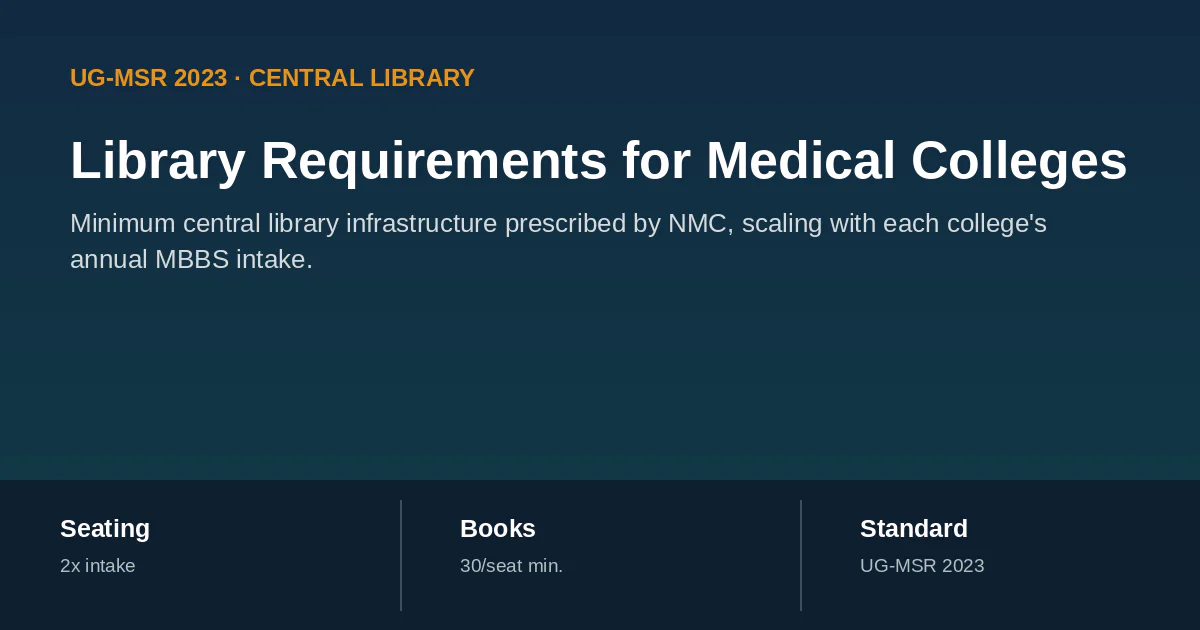
Under UG-MSR 2023, the National Medical Commission prescribes a minimum Central Library infrastructure for every medical college, scaled directly to the college's annual MBBS intake. Reading room seating, computer nodes, book stock, and journal subscriptions all rise in step with seat count, from a 50-seat college through to a 250-seat college. The breakdown below covers each of the five common seat-count tiers.
What are the Library Requirements for a Medical College with 50 MBBS Seats?
For a medical college with an annual intake of 50 MBBS students, the Central Library should have:
Reading room seating: 100 students (twice the annual intake)
Computer nodes with internet: Minimum 13
Books: Minimum 1,500 books (30 books per student intake)
Journals: Minimum 15 national/international journals
Textbooks: At least 5 copies of each prescribed textbook for every 50 students
Separate Faculty Reading Room
Librarian's Room and Library Staff Room
Room for old books and journals
Dedicated Computer Room
Digital library with internet access
At least 60% hard-copy books (for new colleges), with up to 40% e-books permitted
Reference: UG-MSR 2023 – Central Library Requirements.
What are the Library Requirements for a Medical College with 100 MBBS Seats?
For a medical college with an annual intake of 100 MBBS students, the Central Library should have:
Reading room seating: 200 students
Computer nodes with internet: Minimum 25
Books: Minimum 3,000 books
Journals: Minimum 30 national/international journals
Textbooks: At least 5 copies of each prescribed textbook for every 50 students
Separate Faculty Reading Room
Librarian's Room and Library Staff Room
Room for old books and journals
Dedicated Computer Room
Digital library with internet access
At least 60% hard-copy books (for new colleges), with up to 40% e-books permitted
Reference: UG-MSR 2023 – Central Library Requirements.

College leadership regularly reviews infrastructure planning, including library capacity, as MBBS intake grows.
What are the Library Requirements for a Medical College with 150 MBBS Seats?
For a medical college with an annual intake of 150 MBBS students, the Central Library should have:
Reading room seating: 300 students
Computer nodes with internet: Minimum 38
Books: Minimum 4,500 books
Journals: Minimum 45 national/international journals
Textbooks: At least 5 copies of each prescribed textbook for every 50 students
Separate Faculty Reading Room
Librarian's Room and Library Staff Room
Room for old books and journals
Dedicated Computer Room
Digital library with internet access
At least 60% hard-copy books (for new colleges), with up to 40% e-books permitted
Reference: UG-MSR 2023 – Central Library Requirements.
What are the Library Requirements for a Medical College with 200 MBBS Seats?
For a medical college with an annual intake of 200 MBBS students, the Central Library should have:
Reading room seating: 400 students
Computer nodes with internet: Minimum 50
Books: Minimum 6,000 books
Journals: Minimum 60 national/international journals
Textbooks: At least 5 copies of each prescribed textbook for every 50 students
Separate Faculty Reading Room
Librarian's Room and Library Staff Room
Room for old books and journals
Dedicated Computer Room
Digital library with internet access
At least 60% hard-copy books (for new colleges), with up to 40% e-books permitted
Reference: UG-MSR 2023 – Central Library Requirements.
What are the Library Requirements for a Medical College with 250 MBBS Seats?
For a medical college with an annual intake of 250 MBBS students, the Central Library should have:
Reading room seating: 500 students
Computer nodes with internet: Minimum 63
Books: Minimum 7,500 books
Journals: Minimum 75 national/international journals
Textbooks: At least 5 copies of each prescribed textbook for every 50 students
Separate Faculty Reading Room
Librarian's Room and Library Staff Room
Room for old books and journals
Dedicated Computer Room
Digital library with internet access
At least 60% hard-copy books (for new colleges), with up to 40% e-books permitted
Reference: UG-MSR 2023 – Central Library Requirements.

Case-based teaching at the bedside and in the reading room both rely on the same well-stocked reference material.
Why Library Infrastructure Matters at Inspection Time
Central Library infrastructure is one of the non-clinical facilities NMC's Medical Assessment and Rating Board (MARB) verifies directly during inspections, alongside faculty strength and hospital bed capacity. Unlike faculty appointments, which can sometimes be adjusted quickly, library infrastructure — physical seating, book stock, computer nodes, and journal subscriptions — takes longer to scale up, since it involves procurement, cataloguing, and often physical space expansion.
Planning for Intake Increases
Colleges planning to increase their MBBS intake in a future academic year should treat the next seat-count tier's library requirements as a planning checkpoint well ahead of the renewal cycle. Book stock in particular is calculated on a per-seat basis (30 books per student intake), so a jump from 100 to 150 seats requires proportionally adding roughly 1,500 books, along with matching increases in reading room seating and computer nodes. Journal subscriptions and textbook copy counts (5 copies per prescribed textbook per 50 students) should also be reviewed and renewed each academic year to remain compliant, since these are typically verified against current subscription and procurement records rather than historical stock levels.

Related UG-MSR Compliance Guides
Library infrastructure is one of several UG-MSR 2023 requirements that scale with MBBS intake. See also:
For current academic openings, see our faculty vacancy listings across medical colleges.
Source: National Medical Commission, "Guidelines under UG-MSR 2023" — Central Library Requirements.
This article is for general informational purposes based on our reading of the notified regulations and does not constitute legal advice. Requirements can be amended by NMC from time to time — please verify current rules directly with the National Medical Commission before making decisions.