Question:
md with sr in dm department, no dm degree — eligible for ap?
Answer
Yes, you can become Assistant Professor — but in your MD specialty, not in the DM super specialty. This is a very common scenario among doctors who complete a lengthy Senior Residency inside a super-specialty department without ever pursuing the DM/MCh course itself, so it helps to separate the two questions clearly:
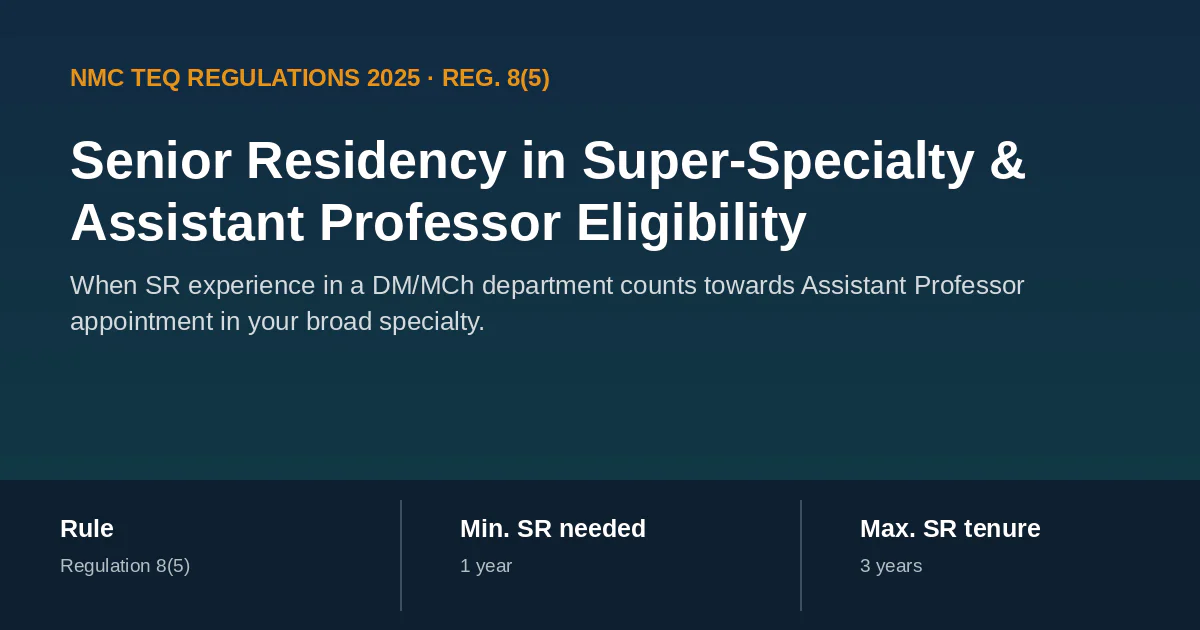
1. Can your SR experience count towards Assistant Professor eligibility? Yes. Under Regulation 8(5) of the NMC's Medical Institutions (Qualifications of Faculty) Regulations, 2025, SR experience gained in a super-specialty department is valid for Assistant Professor appointment, as long as your MD is a recognised feeder qualification for that super specialty (for example, MD General Medicine is a feeder for DM Gastroenterology).
2. Which department can you actually join as Assistant Professor? Your own MD specialty — not the super specialty. A DM/MCh degree is still the mandatory qualification to be appointed as faculty inside a super-specialty department. Your SR tenure there does not substitute for the DM.
So, with an MD and 3 years of SR in a matching super-specialty department, you are eligible for Assistant Professor in your MD subject, with experience to spare (the rule only requires a minimum of one year of SR experience).

Day-to-day ward duties like this often blur the line between an MD holder's own specialty and the super-specialty department they are posted in.
Common Feeder Specialty Examples
Whether your SR tenure counts under Regulation 8(5) depends entirely on whether your MD/MS is a recognised feeder for the super specialty you served in. Some of the most common feeder pairings recognised under the Schedule to the Regulations:
MD General Medicine feeds DM Cardiology, DM Gastroenterology, DM Nephrology, DM Neurology, and DM Endocrinology.
MS General Surgery feeds MCh Urology, MCh Neurosurgery, MCh Surgical Gastroenterology, MCh Cardiothoracic Surgery, and MCh Paediatric Surgery.
MD Paediatrics feeds DM Paediatric relevant super specialties such as Paediatric Cardiology and Paediatric Neurology, but does not automatically feed adult-specialty departments like Cardiology.
If the department you served in doesn't match one of these recognised feeder relationships for your broad specialty, Regulation 8(5) simply doesn't apply to that SR tenure — it's worth double-checking the exact feeder mapping in the Schedule before relying on this provision for a job application or faculty appointment.
Quick Eligibility Checklist
Before assuming your SR experience counts, confirm all three conditions together: you hold a postgraduate broad-specialty degree (MD/MS/DNB); your SR posting was in a department that actually delivers super-specialty (DM/MCh-level) teaching, not just a general clinical rotation; and your broad specialty is listed as a recognised feeder qualification for that specific super specialty. If all three hold, your SR tenure counts towards Assistant Professor eligibility — but strictly in your own broad specialty department, not the super specialty department itself, since a DM/MCh degree remains mandatory for faculty appointment within a super-specialty department.
Keep your appointment letter, SR completion certificate, and rotation records handy when applying — recruiting institutions and NMC verification teams will typically ask for documentary proof of both the department you served in and its super-specialty teaching status, not just a self-declared summary of your SR tenure.
Why This Distinction Matters
The distinction between "eligible in your broad specialty" and "eligible in the super specialty itself" trips up a surprising number of candidates and even some HR teams during faculty recruitment. Getting it wrong in either direction has real consequences: a candidate who assumes SR experience alone qualifies them for a super-specialty Assistant Professor post may have their application rejected at the verification stage, while an institution that mistakenly accepts such a candidate risks a compliance flag during NMC's Medical Assessment and Rating Board inspection. When in doubt, always cross-check the exact feeder relationship for your specific broad specialty and super specialty pairing in the Schedule to the Regulations before finalising an appointment.

Sub-specialty procedures like retinal scanning highlight why a DM/MCh degree, not SR tenure alone, remains mandatory for super-specialty faculty roles.
It's also worth remembering that Regulation 8(5) replaced the older Teachers Eligibility Qualifications in Medical Institutions Regulations, 2022, and formalised a provision that was previously handled more inconsistently across institutions. Candidates who completed their SR tenure before the 2025 Regulations took effect should still check with their institution's faculty affairs office on how transitional cases are being treated, since appointment records finalised under the earlier framework may need to be read alongside the current Schedule for verification purposes.

Related SR-to-Assistant-Professor Eligibility Q&As
This is one of several eligibility scenarios under Regulation 8(5) of the NMC TEQ Regulations, 2025. See also:
SR experience in a super-specialty department — valid for Assistant Professor?
Three years of SR in a super specialty — eligible to join as Assistant Professor?
SR in Gastroenterology after MD Medicine — Assistant Professor eligibility
For current academic openings, see our faculty vacancy listings across medical colleges.
Reference: National Medical Commission, Medical Institutions (Qualifications of Faculty) Regulations, 2025, Regulation 8(5), Gazette of India, 30 June 2025.
This is general information, not legal advice. Please verify with the National Medical Commission before making appointment decisions.