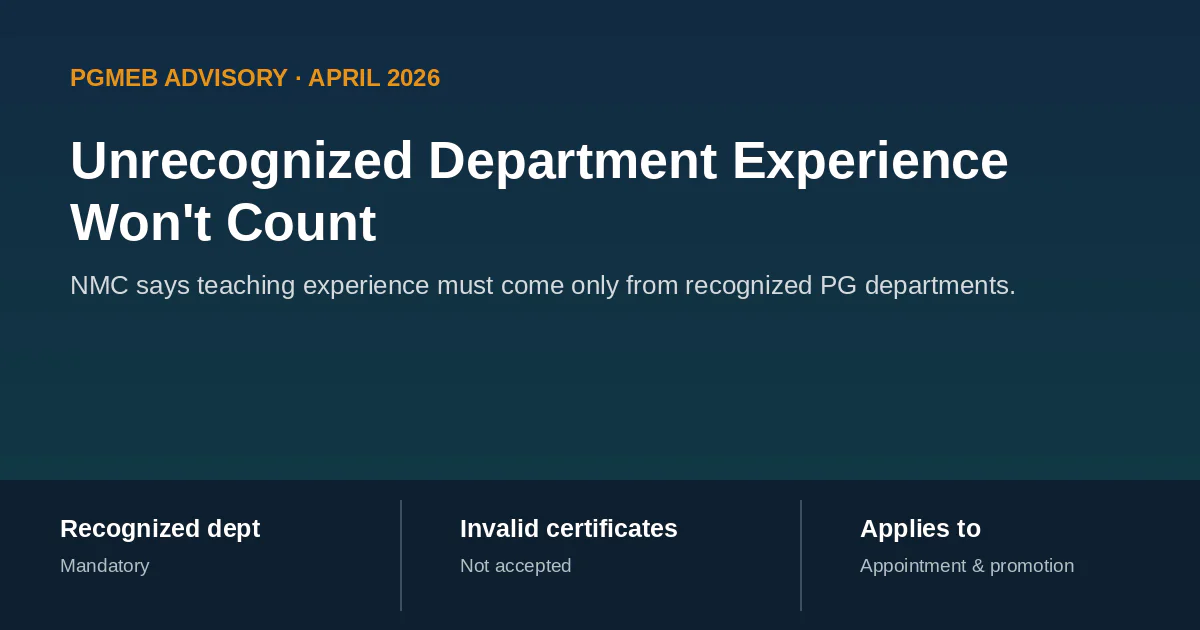
Here's a scenario worth paying close attention to if you're a postgraduate student, a faculty member, or someone who verifies teaching-experience certificates at your institution: not every "teaching experience" claim is going to hold up anymore. On 9 April 2026, the Post Graduate Medical Education Board (PGMEB) of the National Medical Commission (NMC) issued an advisory that draws a hard line — teaching or training experience gained in a department that isn't recognized by NMC simply won't count, no matter what certificate says otherwise.
What Prompted This Advisory
NMC noticed a recurring problem: in certain cases, teaching experience certificates and postgraduate training experience were being claimed by faculty, or certified by universities and institutions, based on departments or units that were never actually recognized or permitted by NMC to conduct postgraduate medical education in the first place. In other words, someone could technically work in a department, get a certificate saying they taught or trained there, and later use that certificate for a purpose it was never actually valid for — because the department itself didn't have NMC's approval to run PG education.
The Rule, in Plain Terms
The advisory reiterates something that's already built into existing regulations — the Postgraduate Medical Education Regulations, 2023 and the Medical Institutions (Qualifications of Faculty) Regulations, 2025 (MIQFR-2025) — but spells it out clearly: teaching experience counts only if it comes from a recognized medical college and a duly recognized teaching department, meaning one that has NMC-approved infrastructure, adequate faculty strength, and permitted postgraduate seats on record.

A faculty member leads bedside teaching for postgraduate students at a rural health center recognized for clinical training.
Where This Applies
NMC has specifically listed the situations where unrecognized-department experience will now be disregarded. It will not be counted for:
eligibility to appear in postgraduate examinations, recognition as a postgraduate teacher or guide, appointment or promotion to faculty positions, and determination of teaching experience for any regulatory, academic, or administrative purpose. That's a broad sweep — it touches students trying to qualify for their PG exams, doctors seeking recognition as PG guides, and faculty applying for appointment or promotion alike. Even routine administrative processes, like verifying years of service for a seniority claim, fall within scope if the underlying department wasn't NMC-recognized at the relevant time.

Certificates Already Issued Aren't Automatically Safe
This is the part that matters most if you're holding an existing certificate. The advisory says any teaching experience certificate issued on the basis of service in an unrecognized department or unit will be treated as invalid for determining eligibility, appointment, promotion, or recognition — regardless of when it was issued or by whom. Having a signed, official-looking certificate from your institution doesn't automatically protect you if the underlying department wasn't NMC-recognized at the time.
What This Means for Universities and Institutions
The responsibility doesn't stop with individual doctors. NMC has placed a clear obligation on medical colleges, institutions, and affiliating universities going forward: teaching experience certificates must only be issued after verifying the recognition status of the concerned department or unit against NMC's own records, and no certificate should be issued at all for experience gained in a department that isn't recognized or permitted by NMC. Institutions are also expected to pass this advisory down to every affiliated college and department under their jurisdiction, so the message doesn't stop at the Vice-Chancellor's or Dean's office.

Pathology faculty examine a microscopy slide together, the kind of hands-on teaching that only counts if the department itself is NMC-recognized.
What You Should Do If This Affects You
If you're a doctor with teaching or training experience you plan to use for a PG exam, a teacher/guide recognition application, or a faculty appointment or promotion, it's worth independently confirming that the department where you gained that experience was NMC-recognized for postgraduate medical education during the period you worked there — not just that the college as a whole was recognized. Recognition is granted department-by-department and course-by-course, with specific approved seats, so a college being generally reputed doesn't guarantee every one of its departments carries PG recognition.
If you're unsure, your institution's academic or administrative office should be able to confirm a department's recognition status against NMC records, since verifying this before issuing any certificate is now an explicit responsibility placed on them by this advisory.
How This Connects to Faculty Eligibility Rules
This advisory sits alongside NMC's broader push to tighten how faculty eligibility gets determined. We recently covered how medical colleges — not PGMEB — are now the primary decision-makers on faculty eligibility and designations under MIQFR-2025; this advisory adds an important guardrail to that process, making clear that the underlying teaching experience being evaluated has to come from a genuinely recognized department in the first place. For more on how specific experience scenarios are assessed, our FAQ on NMC teacher eligibility rules covers related questions on Senior Residency and Assistant Professor eligibility.
This article is based on PGMEB Advisory No. NMC-23(1)(161)/2022/Med/PG dated 09-04-2026 and the covering letter dated 10-04-2026. It is for general information only and is not legal advice. Always verify your specific department's recognition status directly with NMC or your institution.