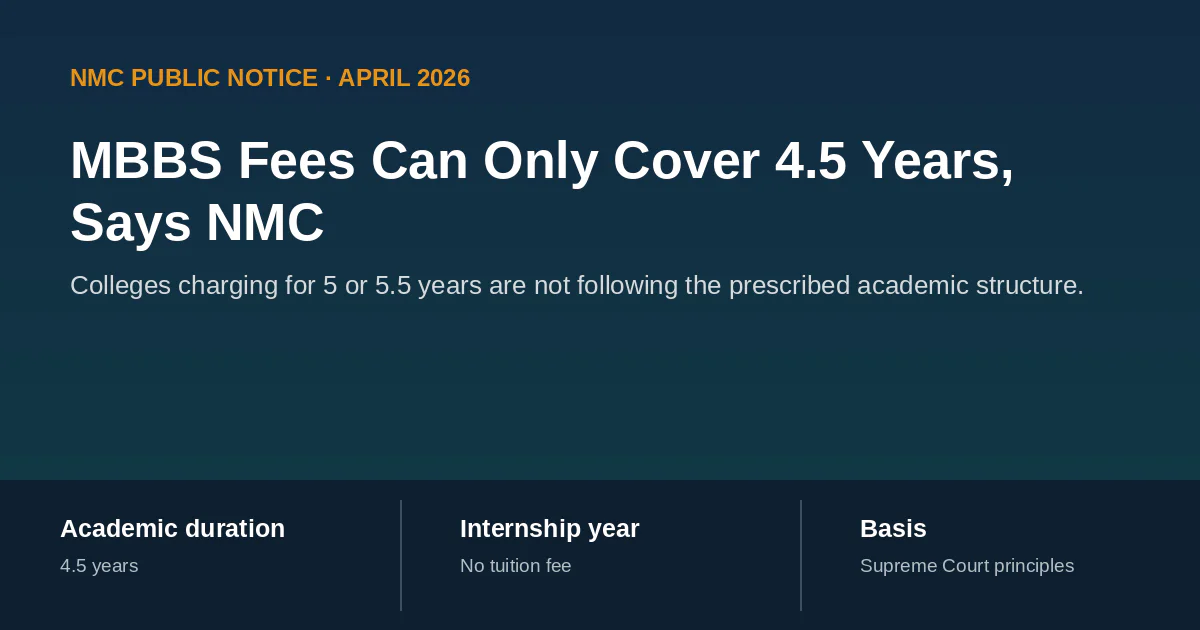
If your medical college charges MBBS students for five full years — or five and a half — you'll want to read this carefully. The National Medical Commission (NMC) issued a Public Notice on 7 April 2026 directly addressing this practice, and the message is unambiguous: tuition fee for the MBBS course can only be charged for 4.5 years of academic study, not for the internship year that follows it. Here's what the notice says, and why it matters for both colleges and students.
What NMC Observed
NMC noted that certain medical colleges, institutions, and universities under its purview were charging MBBS students fees covering the entire duration of 5 years, or even 5½ years. The problem, as NMC frames it, is straightforward: this doesn't match how the MBBS programme is actually structured, and it results in students being charged for a period during which no academic teaching is actually taking place.

Fee structure concerns like these are often first raised in roundtable meetings between college leadership and student families.
How Long Is the MBBS Course, Really?
Under Section 10 and Section 24 of the National Medical Commission Act, 2019, read together with the Competency Based Medical Education (CBME) Guidelines, 2024 framed under the Graduate Medical Education Regulations (GMER), the MBBS programme is prescribed as:
4.5 Years of Academic Study, Plus 1 Year of Internship
That's 4½ years (54 months) of classroom and clinical academic instruction, followed by one year of Compulsory Rotating Medical Internship (CRMI). The internship year is a practical training period, not a fee-paying academic year in the traditional sense — and NMC's notice makes clear that charging tuition-style fees for it isn't consistent with the programme's actual academic structure.

The Legal Backing Behind This Notice
NMC didn't issue this notice in isolation — it points to real, ongoing legal context. It refers to interim directions from the Hon'ble Supreme Court of India in Abhishek Yadav v. Union of India (WP No. 730 of 2022), a case where grievances included non-payment of stipend and the imposition of internship-related charges or fees — issues the Court took serious note of.
The notice also leans on a well-established line of Supreme Court judgments on education fee structures: T.M.A. Pai Foundation v. State of Karnataka, Islamic Academy of Education v. State of Karnataka, and P.A. Inamdar v. State of Maharashtra. Together, these cases have held that fee structures charged by educational institutions must be reasonable, transparent, non-exploitative, and commensurate with the academic facilities and services actually provided. Applying that principle here, NMC's position is that charging fees for a period with no corresponding academic instruction — like the internship year — doesn't hold up against these standards.
What NMC Has Directed
The operative part of the notice is direct: all Medical Colleges, Institutions, and Universities are directed that fees for the MBBS course shall be charged only for the prescribed academic duration of 4.5 years. Beyond that, NMC has also issued a general compliance warning — institutions are expected to strictly follow the NMC Act 2019, applicable Regulations, and relevant court judgments, and any non-compliance will be "viewed seriously," with the Commission initiating appropriate action under existing statutory and regulatory provisions.

The internship year NMC is protecting from extra fees is exactly when students like these residents get hands-on diagnostic training.
What This Means If You're a Student or Parent
If your fee structure or fee receipts show charges extending across a full 5 or 5.5-year span, it's worth checking exactly what that final year or half-year of fees is being billed for. Under this notice, colleges are not supposed to bill tuition-style fees for the internship year — that year is meant to be compensated differently (including stipend obligations, which is part of what the referenced Supreme Court case was examining), not charged for as if it were a continuation of academic teaching.
What This Means for Colleges and Institutions
For medical colleges and universities, this is a clear compliance signal. If your current fee structure spans 5 or 5.5 years, it's worth reviewing it against this notice and adjusting billing so that tuition fees stop at the 4.5-year academic mark, with the internship year handled separately and in line with applicable stipend rules. Given that NMC has explicitly flagged "serious" action for non-compliance, this isn't a notice worth setting aside — colleges that haven't already reviewed their fee structures against it should treat that as a priority item.
This notice is part of a broader pattern of NMC tightening compliance expectations across medical education — from digital records to fee transparency. For related regulatory simplification, see our piece on how NMC removed the Essentiality Certificate requirement for new medical college applications, and our coverage of NMC's ABDM-compliant HMIS integration directive for medical colleges.
This article is based on the NMC Public Notice dated 7 April 2026 (No. CDN-13011/1/2026-Coordination-NMC) on Clarification on Fee Chargeable for MBBS Course Duration. It is for general information only and is not legal advice. Always verify current fee rules with your institution or NMC directly.