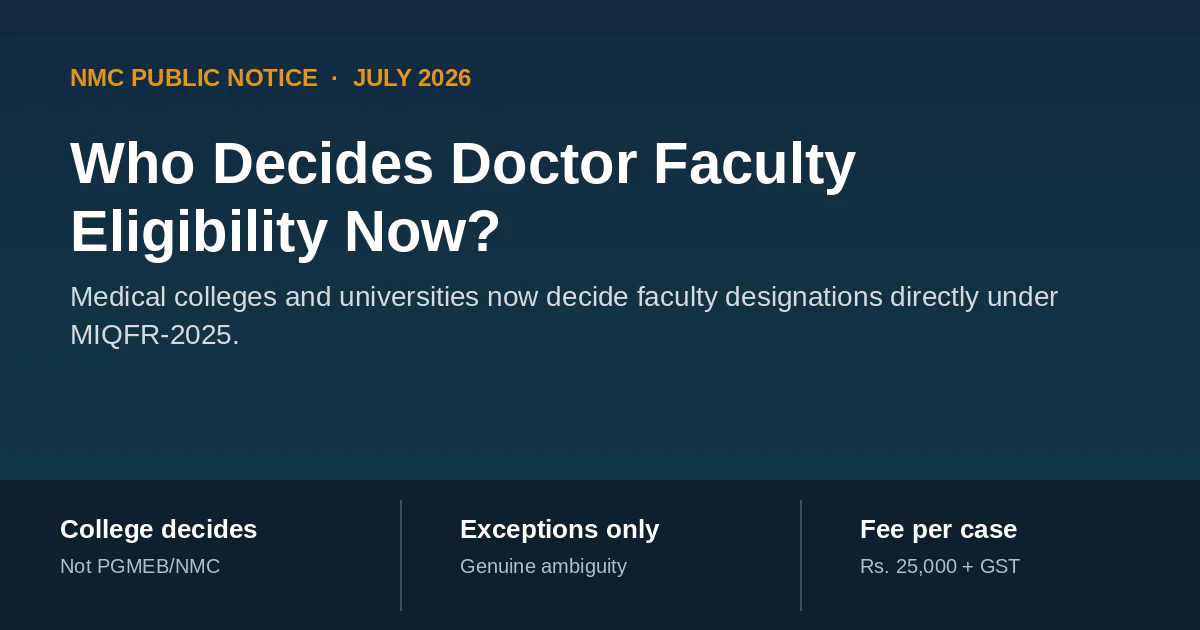
If you're a doctor waiting on an "eligibility certificate" to become an Assistant Professor, Associate Professor, or Professor — or you run a medical college and keep writing to the National Medical Commission (NMC) to confirm a candidate's eligibility — there's an important change you need to know about. As of 17 July 2026, the NMC has made it clear: your own medical college or university now decides faculty eligibility and designations, not the NMC.
This comes from a Public Notice issued by the Post Graduate Medical Education Board (PGMEB), a wing of the NMC, on 16 July 2026, along with a covering letter dated 17 July 2026. Let's break down what it actually means, in plain language.
What the New NMC Notice Actually Says
For years, individual doctors, medical colleges, universities, and even NBEMS-accredited hospitals have been writing to PGMEB asking for "Eligibility Certificates" — basically, a stamp from NMC confirming that a particular doctor qualifies for a particular teaching post (Assistant Professor, Associate Professor, Professor, and so on).
The NMC has now said this needs to stop being the default. All the rules for who qualifies for which teaching position are already laid out in detail in the Medical Institutions (Qualifications of Faculty) Regulations, 2025 (MIQFR-2025), notified on 30 June 2025. These regulations cover qualifications, teaching experience, research publications, and training requirements for every faculty position. Since the rulebook already exists, NMC says there's no need for it to personally certify every single case.

A cardiology team reviews angiography images together, the kind of specialist experience colleges now assess directly against MIQFR-2025.
Why NMC Made This Change
The notice explains that PGMEB was getting flooded with routine requests — cases where the answer was already obvious if you simply read MIQFR-2025 carefully. This was creating unnecessary delays, extra paperwork, and administrative load on a body that's supposed to be handling genuinely difficult or unclear cases. NMC lists five goals behind this change: more accountability at the college level, fewer repetitive routine requests, less burden on PGMEB (and fewer RTIs and court cases as a result), better use of NMC's resources, and faster handling of the cases that actually need expert interpretation.
Who Decides Your Eligibility Now?
This is the core of the notice. The responsibility for deciding whether a doctor is eligible for appointment, promotion, or a particular designation now rests primarily with the medical college, university, or the appointing authority itself — not PGMEB or NMC. If your case is a straightforward read of MIQFR-2025 (for example, "does my MD plus this many years of teaching experience qualify me as Associate Professor?"), your own institution's Dean, Director, Principal, or Registrar is expected to work it out and decide directly, using the regulation itself as the reference.
In other words: your college's competent authority is now the primary decision-maker on faculty designations. PGMEB will no longer issue routine certificates or clarifications for cases that can be settled by simply applying the existing rules.

When Can a College Still Approach PGMEB?
NMC hasn't shut the door completely — it has just narrowed it to genuinely difficult situations. A reference to PGMEB will only be considered when the case involves:
ambiguity or difficulty interpreting a regulatory provision, questions about whether one qualification is "equivalent" to another, transitional provisions (cases caught between old and new rules), or a matter that needs to be read together with other regulations. Even then, several conditions apply. The reference must be sent only through the college's Dean, Director, Principal, or Registrar — individual doctors can't write to PGMEB directly in normal circumstances, and if they do, it simply won't be entertained. The reference also has to clearly point out exactly which provision of MIQFR-2025 is unclear, backed by complete supporting documents and a proper justification.
What It Costs and How Long It Takes
Each reference to PGMEB now comes with a non-refundable processing fee of ₹25,000 plus 18% GST, paid by the applicant through the college or appointing authority. This fee applies per reference, and it isn't refunded even if the college decides not to forward it. Once a genuine, properly documented case reaches PGMEB, the Board is expected to dispose of it within 60 days. PGMEB can decide the case itself, or refer it to an Expert Committee if it's complicated enough to need one. Whatever PGMEB decides — whether that's "yes, eligible," "no, not eligible, with reasons," or "send it back, this isn't actually a hard case" — is treated as final.

Institutional leaders review a campus model, reflecting the greater administrative responsibility colleges now carry for faculty decisions.
What If Your College Doesn't Forward Your Case?
There's a safety net here for doctors. If you genuinely believe your case involves real ambiguity, and your institution hasn't forwarded it to NMC even 60 days after you submitted it, you're allowed to write to PGMEB directly. To do this, you'll need an undertaking confirming your facts are correct, proof that the institution failed or refused to forward your case, all your supporting documents, and proof that you already paid the fee to your institution — plus the ₹25,000 + GST fee to NMC. If the institution really did sit on your case past the 60-day mark, any fee you already paid to them has to be refunded to you.
There's also a review route: if you're unhappy with your college's decision on your eligibility, you can ask NMC to review it directly, within 30 days of that decision, again with the supporting documents and the same fee.
What This Means for Doctors and Medical Colleges
For most doctors, this is actually good news in terms of speed — you no longer have to wait on a certificate from Delhi for a case that MIQFR-2025 already answers clearly. Your own college can, and should, decide it on the spot. The catch is that colleges now carry more responsibility, and more scrutiny, in getting these calls right. If you're preparing to apply for a teaching post or a promotion, it's worth reading MIQFR-2025 yourself and matching your qualifications and experience against it before you even approach your institution — that way, you (and your college) both know exactly where you stand before any file is opened.
For a deeper look at how these eligibility rules actually apply in specific situations — like Senior Residency counting toward Assistant Professor posts — see our FAQs on NMC teacher eligibility, and our earlier piece on NMC's related regulatory simplification move on new medical college applications.
This article is based on our reading of the NMC Public Notice dated 16-07-2026 and covering letter dated 17-07-2026 on MIQFR-2025. It is for general information only and is not legal advice. Rules can be amended by NMC — always verify current requirements with your institution or the NMC directly before taking any action.