NMC Removes Essentiality Certificate Requirement
Major NMC Reform: Essentiality Certificate No Longer Required for New MedicalCollege Applications
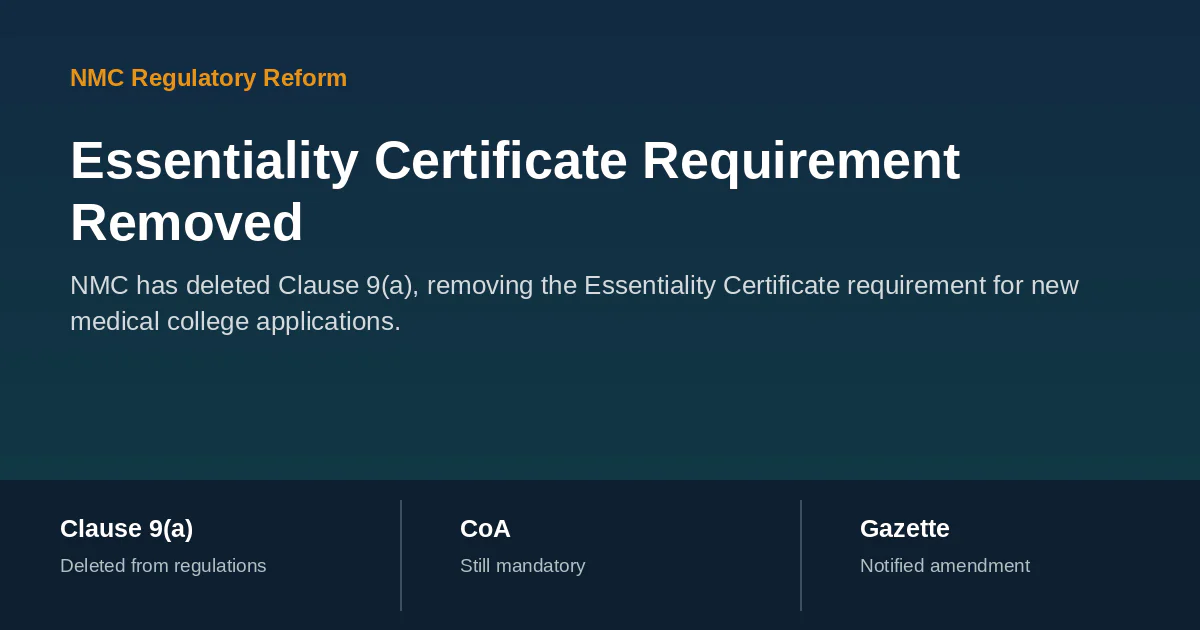
In a landmark regulatory reform, the National Medical Commission (NMC) has officially removed the requirement for submitting an Essentiality Certificate (EC) while applying for the establishment of a new medical college. The amendment has been notified in the Gazette, bringing a significant change to the documentation requirements under the Establishment of New Medical Institutions, Assessment & Rating Regulations.
For years, obtaining an Essentiality Certificate from the respective State Government or Union Territory Administration was one of the most time-consuming steps in the approval process. The requirement often delayed applications because institutions had to obtain multiple state-level approvals before they could even approach the National Medical Commission.
With the latest amendment, Clause 9(a), which required submission of the Essentiality Certificate, has been deleted. As a result, eligible applicants are no longer required to submit this document while applying for the establishment of a new medical college. Instead, applicants must comply with the revised documentation requirements prescribed under the amended regulations, including a valid Consent of Affiliation (CoA) and all other mandatory documents.
For years, obtaining an Essentiality Certificate from the respective State Government or Union Territory Administration added an additional layer of regulatory scrutiny before an application could even reach the National Medical Commission. This requirement often resulted in prolonged processing timelines, as institutions had to satisfy state-level authorities before their proposals could be considered by the NMC. Removing that layer is expected to shorten the overall time between a promoter's decision to apply and NMC's first substantive review of the application.
What Applicants Need to Know
The removal of Clause 9(a) does not mean the approval process itself has become lighter — it means the sequence of steps has changed. Previously, a promoter had to first secure state-level sign-off before NMC would even look at an application; now that state-level gate is gone, but every other document and standard the Medical Assessment and Rating Board (MARB) checks remains fully in force. In practical terms, applicants should expect the same scrutiny on land, hospital capacity, faculty, and financial solvency as before — the only thing that has changed is that the Essentiality Certificate is no longer a prerequisite document.
This also shifts some of the compliance burden earlier in the process. Since there is no longer a state government checkpoint acting as an informal first filter, applicants now carry full responsibility for ensuring their Consent of Affiliation, corpus fund proof, solvency certificate, and hospital capacity documentation are complete and accurate before submission — because MARB's own rules mean an incomplete application is rejected outright, with no opportunity to fix gaps until the next application window opens.
Frequently Asked Questions
Does this amendment apply to applications already in process? The amendment applies from its date of Gazette notification onward; applicants with pending submissions should check with NMC or MARB on how transitional cases are being handled, since the notification governs new documentation requirements going forward.
Is any other document required in place of the Essentiality Certificate? No new replacement document has been introduced — applicants simply no longer need to submit an EC, but the Consent of Affiliation and other Section 9 documents (proof of hospital capacity, corpus fund, solvency certificate, application fee and bank guarantee) remain mandatory.
Does removing the EC requirement make it easier to get a new medical college approved? It removes one procedural step, but MARB's substantive evaluation of infrastructure, faculty, and financial readiness against MSR norms is unchanged, so institutions still need to demonstrate genuine readiness at the time of application.
Does this change interact with the recent seat-capacity reforms under UG-MSR 2023? Yes, indirectly. NMC's April 2026 amendment to UG-MSR 2023 already removed the earlier 150-seat cap and the population-based seat ratio for new colleges and seat increases, and this Essentiality Certificate removal continues that same broader push to simplify entry-stage paperwork while keeping the underlying infrastructure, faculty, and financial standards unchanged. Promoters evaluating a new medical college should read both reforms together rather than in isolation, since one affects how much you can apply for and the other affects what you need to submit to apply at all.
DoctorFaculty Analysis
The removal of the Essentiality Certificate is likely to reduce administrative delays and simplify the application process for eligible institutions. Nevertheless, promoters and medical college managements must recognise that the emphasis has now shifted from obtaining state-level certification to demonstrating complete institutional readiness at the time of application. Institutions planning to establish a new medical college should therefore review the amended regulations carefully and update their compliance strategy accordingly.

Related Guides
For the underlying infrastructure and staffing norms MARB still checks, see also: