Planning to expand your medical college's MBBS seats, or curious about the rules governing where a new medical college can come up? The National Medical Commission (NMC) has just made three important changes to the Establishment of New Medical Institutions, Assessment and Rating Regulations, 2023 (UG-MSR 2023), notified through a Gazette amendment dated 23 April 2026 (published 27 April 2026). Two rules that used to cap how many seats a college could add have been removed entirely, and the rule about how far a college can be from its attached hospital has been redefined. Here's what actually changed, explained simply.
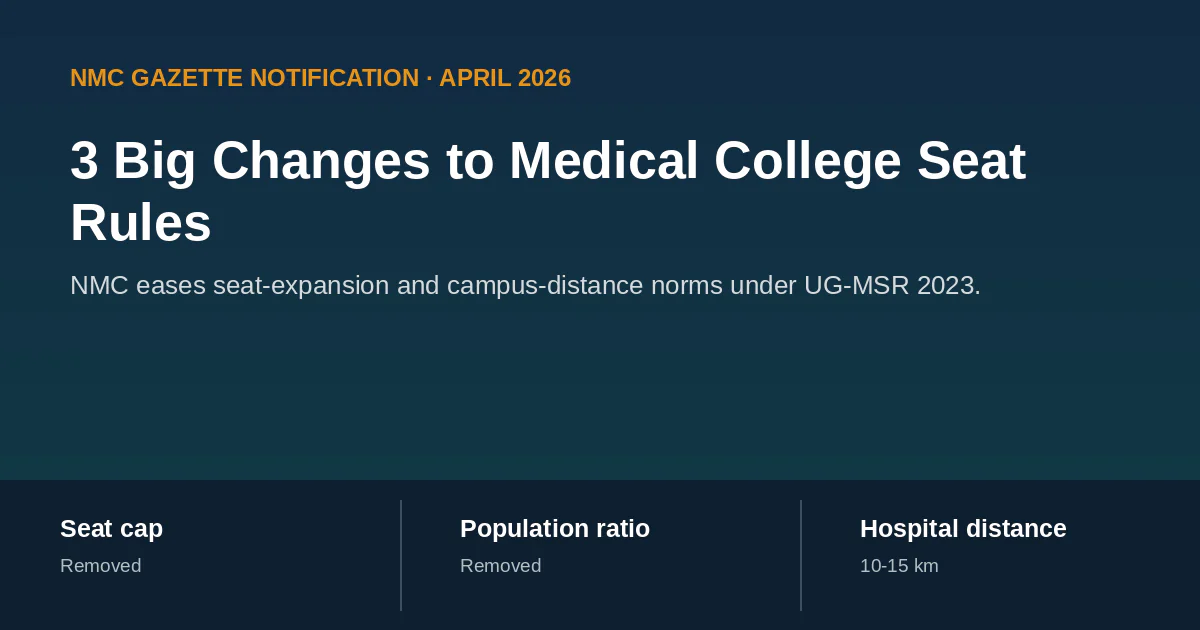
Change 1: The 150-Seat Ceiling Is Gone
Under the earlier UG-MSR 2023 objectives, there was a specific rule: colleges seeking an increase in the number of MBBS seats could not exceed a total of 150 MBBS students from the academic year 2024–25 onward. In effect, even a large, well-resourced college wanting to expand was hard-capped at 150 total seats once it applied for an increase.
The amendment deletes this objective outright. That cap on total seats for colleges seeking to increase intake no longer exists in the regulation. This doesn't automatically mean every college can jump to any number it wants — seat increases still go through MARB's full assessment process — but the fixed 150-seat ceiling that applied specifically to expanding colleges has been removed from the rulebook.
Change 2: No More Fixed Population Ratio
The second deletion is just as significant. UG-MSR 2023 earlier included a proviso requiring that a medical college follow the ratio of 100 MBBS seats per 10 lakh population in that state or Union Territory. This meant seat allocation was tied to a state or UT's population figures — a rule that could work against states with smaller populations but genuine capacity to train more doctors, or restrict expansion in more populous states differently than intended.

Faculty members study together in a college library as institutions weigh how eased seat-cap rules affect their expansion plans.
This proviso has now been deleted from the Objectives chapter of UG-MSR 2023. Medical colleges and state authorities planning new institutions or seat increases no longer need to work around this population-based ratio requirement.
Change 3: Hospital Distance Is Now Measured in Kilometres, Not Minutes
This is the change most likely to affect where new colleges can be sited. The earlier rule, under Schedule I, Clause A.1 (General), stated that the distance between the college and its attached hospital should have "a travel time of maximum 30 minutes." Travel time is a fuzzy, subjective measure — it depends on traffic, time of day, and route, and different assessors could interpret it very differently for the same physical distance.
The amendment replaces this with a fixed distance measurement: the maximum distance between the college and hospital plots is now 10 km. For medical colleges in North Eastern Region states and Himalayan states — where terrain and road conditions genuinely make travel harder — the limit is more generous, at a maximum of 15 km.

Why This Matters for Colleges and Applicants
Together, these three changes point in one clear direction: NMC is simplifying and objectifying the criteria for establishing new medical colleges and expanding existing ones. Removing the 150-seat cap and the population-ratio proviso gives states and institutions more flexibility in planning capacity, while switching from "travel time" to a hard kilometre limit makes site selection and assessment far more predictable — a college can now measure the actual distance on a map instead of guessing how assessors will judge travel time on the day of inspection.
If your institution is currently going through the MARB assessment process — whether for a fresh establishment application or a seat increase — it's worth re-checking your site planning and application documents against these updated norms, since assessments happening after 27 April 2026 will be evaluated under the amended regulation text.

A senior doctor runs a clinical simulation session with residents, the kind of training capacity colleges plan around when adding seats.
What Hasn't Changed
It's worth being clear about what this amendment does not do. It doesn't remove MARB's overall assessment and rating process, and it doesn't automatically approve any pending seat-increase or new-college application — colleges still need to meet every other requirement under UG-MSR 2023, including infrastructure, faculty strength, and hospital bed norms for their intended seat intake. These three changes only remove the specific 150-seat ceiling, the population-ratio proviso, and redefine how hospital distance is measured.
Quick Recap of the Timeline
The amendment notification itself is dated 23 April 2026, issued by the Under Graduate Medical Education Board of NMC under powers given by Section 24(1)(d) read with Sections 26, 28 and 29 of the National Medical Commission Act, 2019. It was then published in the Extraordinary Gazette of India, Part III, Section 4, on 27 April 2026, which is the date these changes formally take effect from a public-notification standpoint. The amendment modifies both the "Guidelines under Regulation 10" of UG-MSR 2023 and Regulation 19 of the Graduate Medical Education Regulations, 2023 — the same regulations originally notified on 16 August 2023.
For a full picture of how MARB evaluates new college and seat-increase applications — including how ratings and penalties work — see our FAQ on MARB assessment, ratings and penalties. And if you're mapping out faculty requirements for a specific seat intake, our breakdown of department-wise faculty requirements for a 250-seat medical college under UG-MSR 2023 is a useful companion read.
This article is based on the NMC Amendment Notification published in the Gazette of India, Part III, Section 4, dated 27 April 2026 (F. No. CDN-19012/2/2025-Coordination-NMC). It is for general information only and is not legal advice. Always verify current requirements against the official Gazette notification and NMC website.