Question
Does experience gained by a Senior Resident (SR) while working in a super-specialty department count as valid teaching experience for appointment as Assistant Professor?
Answer
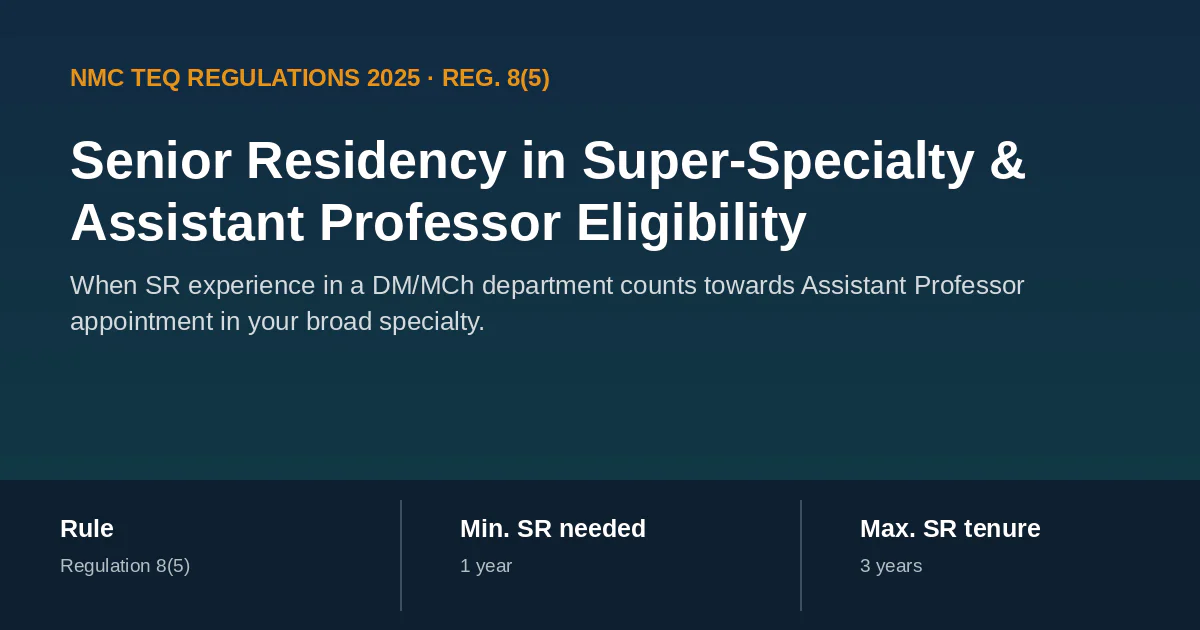
Yes — but only under one specific condition. Regulation 8(5) of the National Medical Commission's Medical Institutions (Qualifications of Faculty) Regulations, 2025 states:
"The experience gained by a Senior Resident having a postgraduate degree and working in a super specialty department offering super specialty teaching shall be valid for appointment as Assistant Professor, provided that such Senior Resident's broad specialty qualification is a feeder qualification for the relevant super specialty."
In plain terms: if you hold a postgraduate degree (MD/MS/DNB) and you serve as a Senior Resident in a super-specialty department, that SR tenure will count towards Assistant Professor eligibility — as long as your MD/MS is a recognised entry ("feeder") qualification for the super specialty you worked in.
Breaking Down the Three Conditions
- You must hold a postgraduate degree. This means MD, MS, or DNB — the broad-specialty qualification defined under Regulation 2(1)(c) and Tables A/B of the Schedule.
- You must be working as a Senior Resident in a super-specialty department that offers super-specialty teaching. A general posting or a non-teaching unit would not qualify; the department must be one imparting super-specialty (DM/MCh-level) education.
- Your broad specialty must be a "feeder qualification" for that super specialty. This is the condition most candidates overlook. Feeder qualifications are fixed by the NEET-SS eligibility framework and the Schedule to the Regulations — not every MD/MS qualifies as a feeder for every super specialty.

Cross-specialty exposure like this often raises the question of whether super-specialty SR time counts toward Assistant Professor eligibility.
What "Feeder Qualification" Means in Practice
A feeder qualification is the broad specialty that is recognised as the entry point for a given DM/MCh super specialty. Some common examples:
| Super Specialty (DM/MCh) | Common Feeder Broad Specialty (MD/MS) |
|---|---|
| Gastroenterology | General Medicine |
| Cardiology | General Medicine |
| Nephrology | General Medicine |
| Neurology | General Medicine |
| Endocrinology | General Medicine |
| Urology | General Surgery |
| Neurosurgery | General Surgery |
| Surgical Gastroenterology | General Surgery |
| Cardiothoracic Surgery | General Surgery |
| Paediatric Surgery | General Surgery |
If your SR posting was in a super-specialty department whose feeder specialty matches your MD/MS, Regulation 8(5) applies. If it doesn't match — for example, an MD Paediatrics graduate doing SR in a Cardiology (adult) department — the condition is not met, and that SR experience would not automatically count under this clause.
Which Department Does the Experience Count Towards?
This is the detail candidates most often get wrong: Regulation 8(5) makes the SR experience valid for appointment as Assistant Professor in your broad specialty — not in the super specialty itself. For example, an MD General Medicine graduate who did SR in Gastroenterology becomes eligible, on this basis, for Assistant Professor in General Medicine. To become Assistant Professor in Gastroenterology itself, a DM (or DNB/DrNB) in Gastroenterology is required under Table C read with Table F of the Schedule — SR experience alone does not substitute for the super-specialty degree.
How Much Experience Is Actually Required?
Separately, Table E of the Schedule sets the general experience bar for Assistant Professor in a medical/surgical broad specialty at just one year of Senior Residency in the relevant subject in a recognised medical institution. Since a Senior Resident post runs for a maximum of three years under Regulation 8(3), most candidates relying on Regulation 8(5) will already have well more than the minimum one year required.
Why This Distinction Matters
The distinction between "eligible in your broad specialty" and "eligible in the super specialty itself" trips up a surprising number of candidates and even some HR teams during faculty recruitment. Getting it wrong in either direction has real consequences: a candidate who assumes SR experience alone qualifies them for a super-specialty Assistant Professor post may have their application rejected at the verification stage, while an institution that mistakenly accepts such a candidate risks a compliance flag during NMC's Medical Assessment and Rating Board inspection. When in doubt, always cross-check the exact feeder relationship for your specific broad specialty and super specialty pairing in the Schedule to the Regulations before finalising an appointment.
It's also worth remembering that Regulation 8(5) replaced the older Teachers Eligibility Qualifications in Medical Institutions Regulations, 2022, and formalised a provision that was previously handled more inconsistently across institutions. Candidates who completed their SR tenure before the 2025 Regulations took effect should still check with their institution's faculty affairs office on how transitional cases are being treated, since appointment records finalised under the earlier framework may need to be read alongside the current Schedule for verification purposes.

Faculty affairs teams must verify feeder-qualification records carefully before finalising an Assistant Professor appointment.
Bottom Line
Yes, super-specialty SR experience counts towards Assistant Professor eligibility — but strictly for appointment in your own broad specialty, and only when that broad specialty is a recognised feeder for the super specialty you served in. Always confirm the feeder relationship in the Schedule before assuming eligibility.

Related SR-to-Assistant-Professor Eligibility Q&As
This is one of several eligibility scenarios under Regulation 8(5) of the NMC TEQ Regulations, 2025. See also:
SR experience in a super-specialty department — valid for Assistant Professor?
Three years of SR in a super specialty — eligible to join as Assistant Professor?
SR in Gastroenterology after MD Medicine — Assistant Professor eligibility
For current academic openings, see our faculty vacancy listings across medical colleges.
Reference: National Medical Commission, "Medical Institutions (Qualifications of Faculty) Regulations, 2025," F. No. N-P051(12)/18/2024-PGMEB-NMC, Regulation 8(5), published in the Gazette of India, Part III–Section 4, dated 30 June 2025.
This article is for general informational purposes based on our reading of the notified regulations and does not constitute legal advice. Candidates and institutions are advised to verify current requirements directly with the National Medical Commission before making appointment decisions.