UG-MSR 2023 FAQs — Part 2: Applicability & Seat Capacity Norms
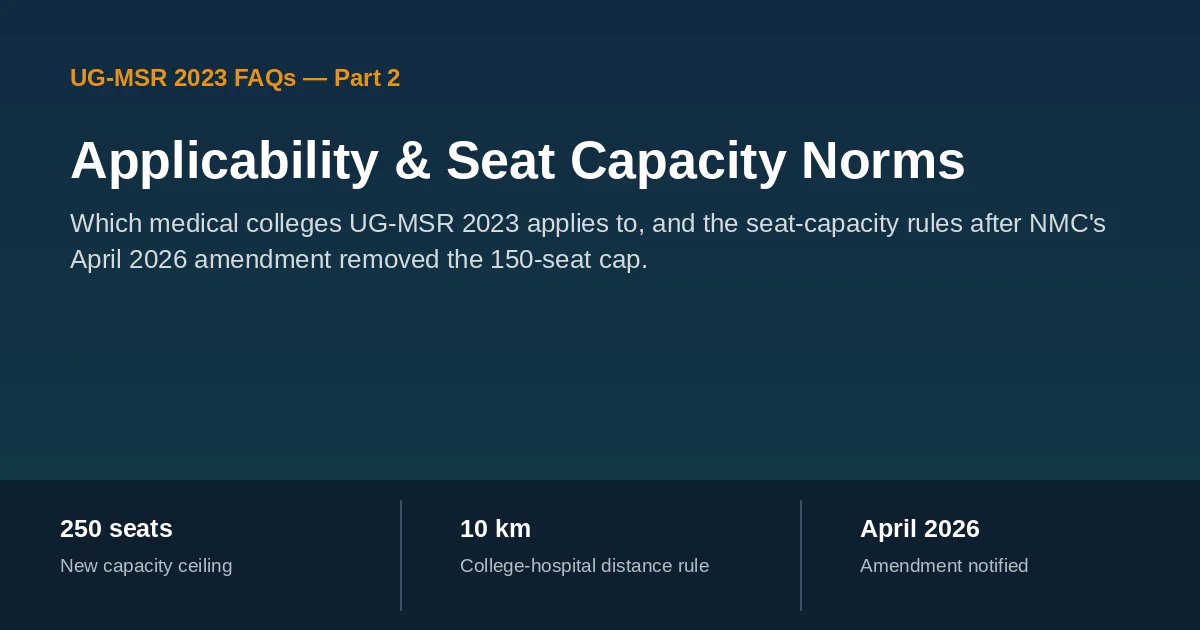
Commonly asked questions on which medical colleges the National Medical Commission's Guidelines under UG-MSR 2023 apply to, and the seat-capacity rules that come with them — updated to reflect NMC's amendment of April 2026, which removed the earlier 150-seat cap and the population-based seat ratio.
from when are the ug-msr 2023 seat norms applicable to medical colleges?
They apply to medical colleges being established from the academic session 2024-25 onwards. Colleges established before this are governed by the regulations that applied at the time, unless they are separately seeking an increase in seats under the new norms.
Source: UG-MSR 2023, Chapter I.
what MBBS seat capacities can a new medical college apply for?
Originally, UG-MSR 2023 allowed new medical colleges to apply only for 50, 100, or 150 seats. NMC's amendment dated April 2026 deleted this restriction, so new colleges can now be set up with higher intake as well — in practice, capacities up to 250 seats, matching the bands already defined in the infrastructure and staff-requirement norms (Schedule I & Schedule II), subject to meeting all other prescribed requirements.
Source: UG-MSR 2023, Chapter I, as amended by NMC Notification F. No. CDN-19012/2/2025-Coordination-NMC, April 2026.
can a college increase its MBBS seats beyond 150 from 2024-25 onwards?
This used to be capped at 150 total MBBS students, with only a narrow one-time exception. That 150-seat ceiling on seat increases has since been removed by NMC's amendment dated April 2026. Colleges can now seek increases beyond 150 — up to the levels defined in the current norms tables (currently 250 seats) — provided they meet all other prescribed requirements.
Source: UG-MSR 2023, Chapter I, as amended by NMC Notification F. No. CDN-19012/2/2025-Coordination-NMC, April 2026.
what conditions must a college meet before it can increase its MBBS seats?
Two conditions apply together: the college's already-admitted batch must fulfil all the criteria for the number of seats admitted in the preceding academic year, and the college must also fulfil all the requirements prescribed for the increased seat capacity it is seeking.
Source: UG-MSR 2023, Chapter I.
can a college admit more students than the seats already sanctioned to it?
No. Any additional permitted seat quota for admission must stay within the number of seats already granted to that college — a college cannot exceed its own sanctioned quota.
Source: UG-MSR 2023, Chapter I.
after academic year 2023-24, for what seat capacities will NMC issue a letter of permission (LOP) for a new medical college?
Originally, LOPs for new medical colleges were issued only for an annual intake of 50, 100, or 150 seats. Following NMC's amendment dated April 2026, which removed the 150-seat cap, LOPs can now be issued for higher capacities as well — up to 250 seats under the current norms.
Source: UG-MSR 2023, Chapter I, as amended by NMC Notification F. No. CDN-19012/2/2025-Coordination-NMC, April 2026.
is there a population-based rule for how many MBBS seats a state can have?
This used to be a requirement — the original UG-MSR 2023 guidelines expected states/UTs to follow a norm of 100 MBBS seats for every 10 lakh population. This requirement has since been removed by NMC's amendment dated April 2026 and is no longer in force.
Source: UG-MSR 2023, Chapter I, as amended by NMC Notification F. No. CDN-19012/2/2025-Coordination-NMC, April 2026.
how many departments are required for MBBS in a medical college?
As per Chapter I of UG-MSR 2023, every medical college/institution approved for undergraduate admissions annually must have the following 21 departments: Anatomy, Physiology, Biochemistry, Pathology, Microbiology, Pharmacology, Forensic Medicine and Toxicology, Community Medicine, General Medicine, Pediatrics, Psychiatry, Dermatology, General Surgery, Orthopaedics, Radio-Diagnosis, Oto-Rhinolaryngology, Ophthalmology, Obstetrics & Gynaecology, Anesthesiology, Dentistry, and Integrative Medical Research.
Source: UG-MSR 2023, Chapter I — Departments.
has the 30-minute travel-time rule between a medical college and its hospital changed?
Yes. The earlier requirement of a maximum 30-minute travel time between the medical college and its teaching hospital has been replaced with a fixed-distance rule: a maximum of 10 km for most states, and 15 km for North-Eastern, Himalayan, and other special-category states.
Source: UG-MSR 2023, Schedule I, as amended by NMC Notification F. No. CDN-19012/2/2025-Coordination-NMC, April 2026.
is there a new fixed maximum on MBBS seats now that the 150-seat cap has been removed?
No. The April 2026 amendment did not replace the deleted 150-seat cap with a new fixed number. Colleges can now expand MBBS intake based on their actual infrastructure and faculty strength, evaluated against the existing norms (currently defined for capacities up to 250 seats), rather than a rigid ceiling.
Source: NMC Notification F. No. CDN-19012/2/2025-Coordination-NMC, April 2026.
which states benefit most from the removal of the population-based seat ratio?
States that were previously constrained by the 100-MBBS-seats-per-10-lakh-population formula — particularly southern states such as Tamil Nadu and Karnataka — stand to benefit most, since they can now seek seat increases without being capped by that population-linked ratio.
Source: Based on NMC's April 2026 amendment to UG-MSR 2023.
when did NMC's amendment removing the 150-seat cap and population ratio come into effect?
The amendment was notified in the Gazette of India in April 2026 (NMC Notification F. No. CDN-19012/2/2025-Coordination-NMC) and took effect immediately from the date of notification.
Source: NMC Notification F. No. CDN-19012/2/2025-Coordination-NMC, April 2026.

Related UG-MSR 2023 Guides
For department-wise staffing and infrastructure norms at each seat capacity, see also:
For current academic openings, see our faculty vacancy listings across medical colleges.
Sources: National Medical Commission (Under Graduate Medical Education Board), "Guidelines under UG-MSR 2023," Notification No. U.11022/3/2023-UGMEB dated 16 August 2023 — Chapter I; as amended by NMC Notification F. No. CDN-19012/2/2025-Coordination-NMC, April 2026.
This article is for general informational purposes based on our reading of the notified regulations and their subsequent amendments, and does not constitute legal advice. Requirements can be amended by NMC from time to time — please verify current rules directly with the National Medical Commission before making decisions.